


In the Thomson Reuters 2026 State of the Corporate Law Department Report, 86% of general counsel said legal significantly contributes to organizational objectives. Only 17% of C-suite executives agreed. A perception gap that wide usually traces back to how the legal function was originally designed and how investment efforts have been coordinated.
All legal departments invest in three things: legal professionals and lawyers (in-house legal talent), tools and processes to deliver the work (service delivery), and a good experience for the business (business experience). But these elements are often designed and optimized separately. As a result, senior counsel may end up reviewing routine NDAs, request forms may reflect legal’s internal filing system rather than what users need, and the business can come to see legal as a “black hole.”
Treating legal as a product or designated service function means asking the following design questions together:
- Who should do which work?
- How should legal work flow from request to resolution?
- What should the business feel when it asks legal for help?
Understanding Why Talent, Delivery, and Experience Drift Apart
In-house legal talent, service delivery, and business experience drift apart because each one has a different owner. Typically, the GC and HR handle hiring, legal ops manages process and tools, and responsibility for the business experience is undefined. Each owner makes decisions within their area, but those areas rarely overlap. A department can recruit excellent lawyers, roll out solid processes, and publish a request form, and still leave the business waiting two weeks for an answer on a low-risk vendor agreement.
The effect of this misalignment is hard to see from inside, but over time, it becomes visible from an outside perspective, which is why general counsel and their executive peers often have such different views of how well the legal function is performing. The business doesn’t see effort or hours. It sees how long an answer took, and whether anyone told it what was happening in the meantime.
1. Who Should Do Which Work?
Instead of assigning legal work by whoever picks it up first, map legal requests by factors like judgment intensity. High-judgment work such as disputes, regulatory strategy, and unusual deal terms, typically belong with senior lawyers. Recurring, rule-based work such as standard NDAs, routine policy questions, and low-value procurement reviews, belong in templates, self-service, and automation.

The CLOC 2026 State of the Industry Report found legal demand rising faster than budgets and headcount, which means the cost of putting senior time on junior work keeps climbing. Intake data shows what work actually comes in. If 40% of requests are standard NDAs and policy questions, but your staffing plan assumes mostly bespoke advisory work, then the plan is misaligned.
2. How Should Legal Work Flow From Request to Resolution?
All legal work should flow through a legal front door, be triaged by type and risk level, and have a status that updates in real time.
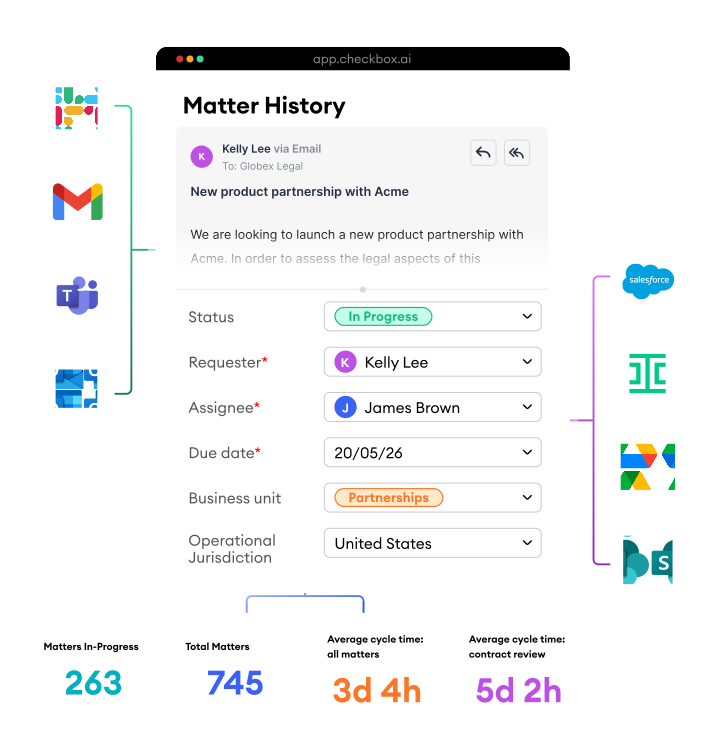
According to Checkbox’s 2025 State of Legal Intake and Visibility Report, 63% of legal teams use multiple, unstructured intake channels. As a result, most departments lack clear visibility into incoming requests, ownership, and urgency. A single legal intake process standardizes how requests come in. Triage rules then route each request to the right process before it becomes an official legal matter. These processes include self-service for routine legal work, a paralegal or operations specialist for standard tasks, and a senior lawyer for complex, high-stakes requests.
Clear status updates are just as important as fast delivery. Requesters will mostly tolerate a two-week turnaround. Silence erodes trust. When a requester can see “in review, expected Friday,” they don’t need to chase anyone to find out the status of their contract.
Consistency matters more than occasional brilliance. A contract process that always takes four days builds more trust than one that sometimes finishes in two days and other times drags on for three weeks, even if both average out the same.
3. What Should the Business Feel When it Asks Legal for Help?
To understand the business’ experience of legal, measure what the requester feels through legal metrics such as response time, cycle time, and requester satisfaction. Matter counts and hours logged describe legal’s workload, but say nothing about the experience of asking legal for help. A department can close a record number of cases in a quarter, yet the overall customer experience can still decline, because the metric does not account for wait times.
The three most important metrics to track in a legal department, regarding business satisfaction for legal teams, are time to first response, intake-to-resolution, and quarterly satisfaction. Time to first response shows the requester that someone has taken ownership. Intake-to-resolution cycle time, broken down by request type, reveals where the process slows down. A short, one-question quarterly satisfaction pulse shows whether these metrics align with how requesters actually experience the service.
What Keeps The Legal Talent, Service Delivery, and Business Experience Aligned?
To keep legal talent, service delivery, and business experience aligned, use a single, consistent source of data to track and monitor how work enters the system. Decisions about staffing, workflow, and performance depend on a clear picture of incoming work — what is being requested, how much of it there is, the level of risk, and how long it takes to complete. That information is only fully accurate at the moment a request is made. When legal intake is fragmented across emails, informal conversations, and multiple forms, those decisions end up based on anecdotes rather than data, and that is how senior lawyers end up handling routine NDAs.
This is where a legal front door proves its value. It acts as the entry point for all requests, automatically capturing them from channels like Slack, Teams, email, or Salesforce, then triaging them by type and risk before sending them off to the appropriate workflow or process. Intake tells you what the business actually needs, routing puts the right level of talent on the right work, self-service handles the requests that never needed a lawyer, and dashboards show the business experience in numbers like response and cycle times. Matter management operates downstream, tracking work after it becomes a matter.
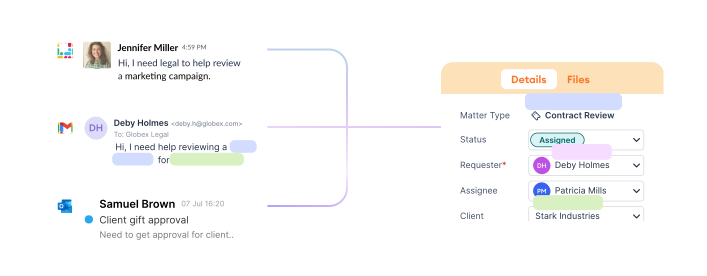
Because all work enters through a single intake point, the talent, delivery, and experience perspectives are no longer separate reports. Instead, they are simply different views of the same dataset.
Key Takeaways
The gap between how GCs and executives rate legal reflects how the function is designed more than how hard it works, and closing it means addressing three design questions together: who does which work, how work flows, and what the business feels. Push rule-based tasks into legal self-service and automation, and use actual intake data to decide the right balance. Measure cycle times and requester satisfaction, since matter counts describe workload rather than the experience of asking for help.
Remember, alignment only holds when all three factors (legal talent, service delivery, and business experience) run on the same data, and that data comes from how work enters.
Book a demo to see how a legal front door keeps talent, delivery, and experience running on the same numbers.


